

Rear End Collision
$2,300,000
Insurer offered$85,000
Spinal cord injury after a rear end crash. The insurer offered $85,000.
Serving Washington, D.C.
Hurt in a crash? The insurance company already has a team working on your claim. You should too. A free call tells you where you stand.
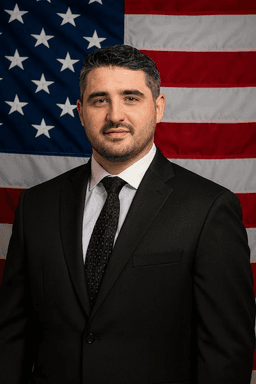 Your attorneyAndranik "Andy" Boyadzhyan, Esq.Founding Attorney. Licensed in Washington, D.C.
Attorney advertising. Services are not available in all states.
By Andranik "Andy" Boyadzhyan, Attorney at Law. Meet the team
In Washington, D.C., a person hurt by a commercial truck claims directly against the trucking company, whose commercial policy is far larger than an ordinary driver's, with no injury threshold to clear, but any fault on the victim's part can bar the claim entirely under the District's contributory negligence rule. Top USA Law locks down the truck's data immediately and puts the fault where it belongs. The consultation is free.
You have a case if a truck driver's carelessness caused the crash, you were hurt, and the evidence shows you did nothing to contribute. That last part matters more in a truck case than almost anywhere else, because a trucking company's insurer will search hard for any share of fault to pin on you. A delivery truck that ran a light on New York Avenue, a tractor trailer that jackknifed on the Southeast Southwest Freeway, or a driver who had been on the road past the federal hours limit on the Beltway was negligent, and District law lets you recover what that negligence cost you if the fault is clearly the driver's.
A loaded tractor trailer can weigh 80,000 pounds, and the injuries in a truck crash are rarely minor. More than one company can share fault: the motor carrier that employed the driver, the owner of the trailer if it was leased, a maintenance contractor that missed a defect, and in some cases a freight broker or the company that loaded the cargo. Each one carries its own insurance policy.
Trucking companies respond within hours of a serious crash, often sending an investigator before the wreckage is cleared, to control the evidence and, in a contributory negligence jurisdiction, to build a fault argument against you before you have left the hospital. That is why the timing of your call matters more in the District than in almost any other jurisdiction we handle.
Two things shape every District truck claim. The first is contributory negligence, covered below, which makes early evidence the whole case. The second is where the crash happened: a crash inside the District follows District rules, and a crash outside it does not. If your crash happened outside the District, we say so in the first conversation and help you find the right counsel.
The District is an at fault jurisdiction. You bring your claim directly against the trucking company's commercial liability insurer, and you can seek medical costs, lost income and pain and suffering in one claim with no serious injury threshold to clear. Federal law requires interstate motor carriers to carry far higher minimum policy limits than an ordinary driver, often 750,000 dollars and up to 5,000,000 dollars for hazardous cargo, which is a major reason truck cases are valued differently from car cases.
Whether you recover at all depends on fault. The District follows contributory negligence, one of the harshest rules in the country: if the insurer can show you were even slightly at fault, your claim can be barred entirely. There is no comparative reduction, no partial recovery. Early evidence that places all of the fault on the truck driver is not a detail in a District truck case, it is the whole case.
The District requires liability and uninsured motorist coverage on every registered vehicle under D.C. Code 31-2403. Because contributory negligence can bar a claim against the driver entirely in a close case, we also review your own uninsured and underinsured motorist coverage in every District truck case.
Government and transit vehicles complicate matters further. A crash with a Metrobus is a claim against WMATA, an interstate compact agency with its own claims process, and a crash with a District government truck carries a six month notice requirement. We identify the owner of every vehicle involved in the first week.
A claim is worth the sum of what the crash took from you, built one category at a time. Economic damages are the measurable losses: medical bills, future treatment, lost wages and benefits, reduced earning capacity, and out of pocket costs. Non economic damages cover pain and suffering, loss of enjoyment of life, and scarring. The District has no injury threshold and no general cap on these damages in a truck case.
Truck crash injuries tend to be severe given the forces involved: spinal fractures, crush injuries, traumatic brain injury, internal injuries and amputation are common. A surgery moves a claim into a different tier, and a permanent injury or wrongful death is valued in its own category. Because the trucking company's commercial policy is usually large, insurance is often adequate to fully value a serious case, which is why identifying every liable party matters.
Fault is the ceiling in the District, and in a truck case it is a cliff rather than a slope. A claim that a comparative fault state would pay at a reduced percentage after a partial fault finding can be worth nothing here if a jury finds the victim contributed at all. That is why the value of a District truck case depends as much on camera footage, the truck's electronic data and witness statements as on the medical records.
We do not quote a number on the first call. We preserve the truck's data, gather the federal compliance record, retain an accident reconstruction engineer where needed, and, when your doctors can describe your future, put a demand on paper backed by evidence. Past results do not guarantee a similar outcome. Each case is decided on its own facts.
Expect the fault argument first, and expect it from a well funded defense. A trucking company's insurer in a contributory negligence jurisdiction searches every file for any share of blame to attach to the victim, because doing so can end the claim completely rather than merely reduce it.
We answer with evidence gathered before it fades: the truck's engine control module and electronic logging device data, dash camera footage, the Metropolitan Police crash report, the other driver's phone records and witness statements. The engine control module can show speed and braking in the seconds before impact, and electronic logs can show whether the driver had exceeded federal hours of service limits. Both can be lost within days under a carrier's routine retention policy, which is why we send a preservation demand immediately and seek a court order if a carrier refuses.
The District recognizes a doctrine called last clear chance: even where a victim was careless, a driver who had the last clear opportunity to avoid the crash and failed to take it can still be held fully responsible. It is a narrow doctrine, but it is often the answer to a contributory negligence defense in a truck case where the driver had every opportunity to see and avoid a slower or stopped vehicle.
Beyond fault, insurers argue that treatment was excessive or that injuries were pre existing. We answer with treating physicians, objective imaging and, where needed, a narrative report tying the injury to the crash. If the carrier will not pay a fair number once the federal safety record and medical picture are complete, we file suit in the Superior Court of the District of Columbia.
The District gives you three years from the date of the crash to file a personal injury lawsuit under D.C. Code 12-301. A wrongful death action must be brought within two years of the death under D.C. Code 16-2702.
Claims against the District government have a much shorter fuse: D.C. Code 12-309 requires written notice to the Mayor within six months of the injury as a precondition to suing the District, for any crash involving a District vehicle or a dangerous road the District maintains.
WMATA has its own claim procedures for Metrobus crashes, and federal vehicles are claimed against the United States through an administrative process. None of these statutory deadlines are the real risk in a truck case, though. Electronic logging device data, engine control module downloads and dash camera footage can be destroyed or overwritten within days under a carrier's routine retention schedule unless a preservation letter arrives first.
Insurance deadlines run separately and sooner, and every policy requires prompt notice of the crash. Call us immediately so the preservation letter and every other notice goes out without delay.
See a doctor the same day, even if you feel more shaken than hurt. Truck crash injuries are not always obvious right away. MedStar Washington Hospital Center and George Washington University Hospital are the District's Level I trauma centers for serious injuries.
Make sure a Metropolitan Police crash report exists and get the report number. Photograph both vehicles, including the truck's DOT number and company markings, the road, signals, debris and skid marks and your injuries. Get the other driver's information and the names and numbers of witnesses, which matter more here than almost anywhere because of contributory negligence.
Call us immediately so we can send a preservation letter to the motor carrier for the truck's black box data, electronic logs, dash camera footage, driver file and maintenance records, before any of it can legally be destroyed under a routine retention schedule. Look for DDOT traffic cameras and nearby business cameras as well; that footage is often overwritten within days.
Notify your own insurer that a crash occurred. Do not give a recorded statement to the trucking company's insurer or investigator, do not accept a quick check, and do not discuss fault with anyone but your lawyer, including on social media. In the District a single sentence conceding a small share of blame can end the claim.
See if you have a case
Three answers and a phone number. An attorney reviews your situation and calls you back, free.
Rear End Collision
$2,300,000
Insurer offered$85,000
Spinal cord injury after a rear end crash. The insurer offered $85,000.
T Bone Accident
$1,800,000
Insurer offered$120,000
Broken pelvis and internal bleeding at an intersection. The insurer offered $120,000.
Drunk Driver Victim
$1,500,000
Insurer offered$50,000
Traumatic brain injury caused by an impaired driver. The insurer offered $50,000.
Every case is different. Past results do not guarantee, warrant, or predict a similar outcome.
Top USA Law meets District clients at 700 12th St NW, Suite 700, Washington, DC 20005, a few blocks from the Superior Court of the District of Columbia. Our main office is at 411 Hackensack Ave, 2nd Floor, Hackensack, NJ 07601. Every office is reached through one number, (877) 411-5291, answered around the clock. Andranik "Andy" Boyadzhyan, the firm's founding attorney, is licensed in the District of Columbia and handles District matters.
District truck accident lawsuits are filed in the Civil Division of the Superior Court of the District of Columbia. Claims against the United States are heard in the United States District Court for the District of Columbia after the administrative claim is exhausted.
The crashes we see most involve freight and delivery trucks on the Southeast Southwest Freeway, the Anacostia Freeway and the District portions of Interstates 295 and 395, and box trucks and delivery vehicles downtown along New York Avenue and Rhode Island Avenue. Crashes on the Capital Beltway often sit outside the District line, and we confirm where the crash happened before anything else.
We handle claims against interstate motor carriers, local delivery fleets, and, where a load shifted or a trailer failed, against the company responsible for loading or maintaining the vehicle, as well as claims involving Metrobus, District government vehicles and federal vehicles.
Contributory negligence is the District's general rule, established by case law rather than a statute: a driver or passenger whose own negligence contributed to the crash in any degree is barred from recovering. It applies fully to truck accident claims by drivers and passengers of other vehicles.
D.C. Code 31-2403 requires liability and uninsured motorist coverage on every vehicle registered in the District. D.C. Code 12-301 sets the three year deadline to file a personal injury lawsuit, and D.C. Code 16-2702 sets the two year deadline for a wrongful death action.
D.C. Code 12-309 requires written notice to the Mayor within six months as a precondition to suing the District of Columbia. D.C. Code 50-2201.05 requires a driver to report a collision to the Metropolitan Police Department, and D.C. Code 50-2201.05c makes leaving the scene of an injury crash a criminal offense.
Federal motor carrier safety regulations, enforced alongside District law, govern a trucking company's duties on driver hours, vehicle maintenance, drug and alcohol testing and cargo securement, and a violation of those federal rules is strong evidence of negligence in a District case.
Hurt in a crash? Talk it through for free.
Washington, D.C. filing deadlines and insurance notice rules can be short. A free call tells you where your clock stands.
Last reviewed by Andranik "Andy" Boyadzhyan, Esq., October 2026.
Three fields. We respond fast, day or night.
Hit by a semi truck on the highway. Top USA Law knew exactly how to deal with the trucking company. Got me $425,000 after they initially offered $30,000.
Client testimonials. Testimonials are not a guarantee, warranty, or prediction of the outcome of your case.
Top USA Law. Services are not available in all states.
Takes 30 seconds. No obligation.