


Andranik "Andy" Boyadzhyan, Esq.
Founding Attorney
Licensed in Alabama, Missouri, New Mexico and Washington, D.C.
Featured in CNN, Forbes, Variety
Serving Missouri
Hurt in a crash? The insurance company already has a team working on your claim. You should too. A free call tells you where you stand.
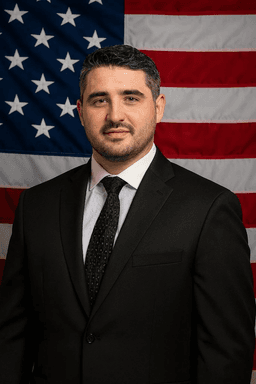 Your attorneyAndranik "Andy" Boyadzhyan, Esq.Founding Attorney. Licensed in Missouri.
Attorney advertising. Services are not available in all states.
By Andranik "Andy" Boyadzhyan, Attorney at Law. Meet the team
In Missouri, being partly to blame does not by itself bar a crash claim: your recovery is reduced by your share of fault, though a 100 percent share leaves nothing. That rule comes from a Missouri Supreme Court case; the statute on this page covers only defective product claims. Top USA Law can help. Call (877) 411-5291.
Not for an ordinary crash. Its own text limits it to products liability claims; the general crash rule comes from the Missouri Supreme Court.
Search for Missouri comparative fault and RSMo 537.765 comes up first, because it uses the phrase "pure comparative fault." Read the first subsection and the scope is plain: "Contributory fault, as a complete bar to plaintiff's recovery in a products liability claim, is abolished. The doctrine of pure comparative fault shall apply to products liability claims as provided in this section." A products liability claim is a claim that something made or sold was defective, such as a tire that separated on I-44 or an airbag that failed in a crash on I-70.
An ordinary crash claim is not about a product. It is about a driver who looked at a phone, ran a light on Grand Boulevard in Kansas City or followed too closely on Route 141 in St. Louis County. For those claims, Missouri's shared fault rule is case law, not this statute, and this page explains both.
Andranik "Andy" Boyadzhyan, licensed in Missouri, reviews our Missouri pages. Top USA Law's main office is in Hackensack, New Jersey, and Missouri clients work with us by phone and video. You pay no fee unless we win, and costs may apply.
It abolishes contributory fault as a complete bar in products claims, makes the defendant raise and prove your fault, and lists six kinds of fault.
RSMo 537.765 has three subsections, in effect since July 1, 1987.
That third subsection matters. In a products claim, the defense cannot point to any carelessness it likes; the conduct must fit one of the six listed categories. The statute does not mention drivers, roads or crashes at all.
Top USA Law. Services are not available in all states.
Fill in four quick fields, and a licensed attorney reviews the facts of your case at no cost.
Only when the case includes a products claim, such as a defective tire, brake, seat belt or airbag, alongside the claim against a driver.
One crash can produce two kinds of claim. Suppose a driver rear-ends you on I-55 south of St. Louis and your seat belt latch releases. Your claim against the driver is an ordinary negligence claim. A claim that the latch was defective is a products claim against the company that made or sold it, and RSMo 537.765 governs how your own fault, if any, is weighed in that part. A tread separation on a highway, a stuck accelerator or an airbag that did not deploy can raise the same question.
Products claims depend on physical evidence. Keep the vehicle, or at least the failed part, out of the salvage auction until it can be inspected, and tell your insurer in writing that you want it preserved. Photograph the tires, the belts and the dashboard warning lights. Once a vehicle is crushed, the proof for a products claim can be seriously weakened.
From Gustafson v. Benda (Mo. banc 1983): pure comparative fault, no 50 or 51 percent cutoff, though a 100 percent share leaves nothing.
In Gustafson v. Benda, 661 S.W.2d 11 (Mo. banc 1983), the Missouri Supreme Court took a case that began when a motorcycle passing a car collided with it as the car turned left at a T intersection. The court adopted pure comparative fault and wrote that "this and future cases shall apply the doctrine of pure comparative fault," replacing the old all-or-nothing rule. That is the rule for an ordinary Missouri car crash today.
Here is how it works. The factfinder, a jury or a judge sitting without one, assigns each party a percentage of fault. Your damages are reduced by your share. If your losses are found to be one hundred thousand dollars and you are found 30 percent at fault, the award is seventy thousand dollars. Past results do not guarantee a similar outcome. Missouri sets no 50 or 51 percent cutoff, so a person found 60 percent at fault can still recover 40 percent of the damages. A person found 100 percent at fault recovers nothing.
A defendant 51 percent or more at fault can owe the whole judgment; one under 51 percent generally pays only its share.
A different statute, RSMo 537.067, deals with defendants, not with you. In a tort case with more than one defendant, a defendant found 51 percent or more at fault is "jointly and severally liable for the amount of the judgment," which means you can collect all of it from that defendant. A defendant found less than 51 percent at fault "shall only be responsible for the percentage of the judgment for which the defendant is determined to be responsible by the trier of fact," with exceptions where the other defendant was the party's employee or a federal Employers' Liability Act duty applies. Punitive damages are split by fault share only. This affects how much you can collect from each defendant, not the reduction for your own share. In a crash with a careless driver and a defective part, it can decide whether the driver or the manufacturer pays most of the award.
Five years for injury, three for wrongful death (not counting a defendant's absence); a city street or sidewalk defect can need notice to the mayor.
An injury claim falls under RSMo 516.120, which allows five years for "any other injury to the person or rights of another." A wrongful death action must start within three years under RSMo 537.100; time a defendant is absent from the state does not count, and a new action can follow within one year of a nonsuit. If a defect in a city street rather than a driver or product is part of the claim, a city of one hundred thousand or more needs written notice to the mayor within 90 days under RSMo 82.210. Ask a lawyer early whether a products claim raises any other timing issue, because the evidence and the parties differ.
Under subsection 4 of RSMo 508.010, when the plaintiff was first injured in Missouri, venue is the county where that injury happened, so a crash on I-70 in Boone County goes to the Boone County Circuit Court. Both the negligence claim and the products claim can be brought in one case.
Get treated, keep the vehicle and any failed part, get the crash report, and see a lawyer before a recorded statement to the other insurer.
See our Missouri car accident laws guide and the partly at fault guide, or call (877) 411-5291. No Fee Unless We Win (Costs May Apply).
We serve Missouri clients by phone, video and in person appointments arranged case by case, and calls are answered 24 hours a day.
You have five years to sue for an injury and three years after a death. A claim over a broken city street or sidewalk may need written notice to the mayor within 90 days.
A licensed Missouri attorney, Andranik "Andy" Boyadzhyan, Founding Attorney, reviews every Missouri claim, and our team helps you in English or Spanish.
Andranik "Andy" Boyadzhyan, Esq.
Founding Attorney
Licensed in Alabama, Missouri, New Mexico and Washington, D.C.
Featured in CNN, Forbes, Variety

Paul Perkins, Esq.
Of Counsel
Licensed in New Jersey and New York
Certified by the New Jersey Supreme Court as a Civil Trial Attorney. Lawyer of Distinction in Civil Litigation.
Featured in CNBC, Bloomberg, Forbes, The New York Times
Andranik "Andy" Boyadzhyan is the founding attorney of Top USA Law. His background spans business law, civil litigation, and personal injury, and his practice today focuses on motor vehicle accident claims.
Sundas Shafi, Esq., Attorney at Law, Head of Litigation
Rosette Kalayjian, Attorney at Law
Sandra Alves, Case Manager
Four steps from your first call to the close of your claim. You focus on healing while we deal with the insurers and keep you updated.
Free consultation
Call 24/7 or send the short form. An attorney reviews what happened and tells you where you stand. Free, no obligation.
We deal with the insurers
We deal with the insurance companies, request the police report and medical records, and keep you updated.
We build your case
Evidence, witnesses, experts and the medical picture of your injuries, prepared as if the case will go to trial.
You get paid
Medical bills, lost wages, vehicle damage, and pain and suffering. No fee unless we win; costs may apply.
Reviewed by Andranik "Andy" Boyadzhyan, Esq.
Fill in the four short fields in this form, and a licensed attorney reviews your case for free. We respond day or night.
Top USA Law. Services are not available in all states.
Takes 30 seconds. No obligation.