

Pedestrian Hit by Car
$725,000
Insurer offered$25,000
Hip fracture and concussion in a crosswalk. The insurer offered $25,000.
Serving Birmingham, Alabama
Hurt in a crash in Birmingham? The insurance company already has a team working on your claim. You should too. A free call tells you where you stand.
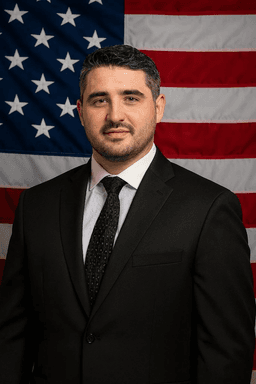 Your attorneyAndranik "Andy" Boyadzhyan, Esq.Founding Attorney. Licensed in Alabama.
Attorney advertising. Services are not available in all states.
By Andranik "Andy" Boyadzhyan, Attorney at Law. Meet the team
In Alabama, a pedestrian hit in Birmingham claims medical bills, lost pay and pain and suffering from the careless driver's liability insurer. Under Alabama common law, the walker's own negligence can bar the claim if it helped cause the injury, unless the driver acted wantonly, meaning with reckless disregard. Call Top USA Law at (877) 411-5291.
The walker claims against the driver's insurer; the walker's own negligence can bar the claim, unless the driver acted wantonly, meaning with reckless disregard.
People walk in Birmingham for every reason. They head to a bus stop on 3rd Avenue North, cross University Boulevard between UAB buildings, or walk home from a shift along Finley Boulevard. Some walk to a store on Greensprings Highway. At night, a person in dark clothes can be hard to see until the last second.
Alabama has no personal injury protection law, so no auto policy has to pay a pedestrian's medical bills up front. The injured walker claims against the driver who caused the crash, and that driver's liability insurer pays if the claim succeeds. In the meantime, a health plan pays under its terms. Some auto policies include medical payments coverage that can reach a policyholder hurt on foot; read the policy to see whether yours does.
The hard part in Alabama is fault. Under the state's common law contributory negligence rule, a walker whose own negligence helped cause the injury, even slightly, can lose the whole claim. That rule does not apply when the driver acted with wantonness, meaning conscious or reckless disregard of a known risk, and it is the reason the first weeks of evidence gathering matter so much here.
Andranik "Andy" Boyadzhyan, Attorney at Law, licensed in Alabama, handles Top USA Law's Alabama cases. Our main office is in Hackensack, New Jersey. We have no Birmingham office, so we meet by phone or video, or arrange a visit at home or in the hospital. No Fee Unless We Win (Costs May Apply).
See if you have a case
Three answers and a phone number. An attorney reviews your situation and calls you back, free.
Federal data lists 16 pedestrians killed in Jefferson County in 2024, eight in Birmingham, and 15 of the 16 died after dark.
NHTSA's Fatality Analysis Reporting System (FARS) records 16 pedestrian deaths in Jefferson County in 2024: eight in Birmingham, four in Bessemer, one in Hueytown and three outside city limits. The Birmingham locations are Interstate 59, Interstate 65, Greensprings Highway, Edward Lakes Road, Medical Park Drive East, 4th Avenue North, Daniel Payne Drive and Finley Boulevard. In Bessemer, three of the four were on 19th Street, 9th Avenue and 8th Avenue North.
Two patterns stand out. Fifteen of the 16 deaths happened in darkness. None of the 16 walkers was in a marked crosswalk. FARS places 12 on the roadway away from an intersection and three on a shoulder or roadside. FARS counts deaths, not injuries, and it does not decide who was at fault in any crash.
Without working signals, drivers yield to walkers in a crosswalk on or near their half; all drivers owe due care, and walkers outside crosswalks yield.
Where signals are not working, Ala. Code section 32-5A-211 requires a driver to "yield the right-of-way, slowing down or stopping if need be to so yield, to a pedestrian crossing the roadway within a crosswalk" when the walker is on the driver's half of the road or close to it. A driver may not pass a car stopped at a crosswalk for a pedestrian. A separate rule applies everywhere, in Ala. Code section 32-5A-213: "Notwithstanding any provision of law to the contrary, every driver of a vehicle shall exercise due care to avoid colliding with any pedestrian". The driver must also sound the horn when necessary. Special care is owed to children and to anyone "obviously confused, incapacitated, or intoxicated."
Ala. Code section 32-5A-212 says a pedestrian crossing "at any point other than within a marked crosswalk or within an unmarked crosswalk at an intersection shall yield the right-of-way to all vehicles upon the roadway", and between two working signals may cross only in a marked crosswalk. Under Ala. Code section 32-5A-215, a walker must use a practicable sidewalk, then the shoulder; with neither, the walker stays near the outside edge and, on a two-way road, uses the left side. A walker may not step off a curb into the path of a car too close to stop.
Possibly not for ordinary negligence; contributory negligence can bar the claim, but not against wantonness, meaning conscious or reckless disregard of a known risk.
Insurers use those walker rules as a weapon. If you crossed Greensprings Highway away from a corner at night, the adjuster may say your own negligence helped cause the crash and that Alabama law bars you.
Two answers matter. First, crossing outside a crosswalk does not prove on its own that the walker's conduct caused the injury. A driver who was speeding, looking at a phone or never braking still broke the 32-5A-213 duty of due care, and cause is argued with evidence. Second, under Alabama common law, contributory negligence is no defense to wantonness. Ala. Code section 6-11-20(b)(3) defines wantonness as "Conduct which is carried on with a reckless or conscious disregard of the rights or safety of others." A drunk driver, or one racing through a neighborhood, can fit that definition.
The proof that answers these arguments disappears quickly: business and bus stop cameras, streetlight conditions, the car's damage and the driver's phone records. Ask stores along the route to keep their video.
In each case, the insurance company made a first offer. Here is what our clients received instead. Past results do not guarantee a similar outcome.
Pedestrian Hit by Car
$725,000
Insurer offered$25,000
Hip fracture and concussion in a crosswalk. The insurer offered $25,000.
Every case is different. Past results do not guarantee, warrant, or predict a similar outcome.
Health coverage may help first; the insurer pays a proven claim. Sue in two years; city claims need six months' notice and a sworn statement.
Ala. Code section 32-7A-4 requires a liability policy, a bond or a cash deposit for vehicles driven on public highways. The minimums in Ala. Code section 32-7-6(c) are twenty-five thousand dollars for one person's injury and fifty thousand dollars for two or more people per accident. Past results do not guarantee a similar outcome. What if the driver had no insurance or too little? Uninsured motorist coverage under Ala. Code section 32-7-23, on your own auto policy or a household policy, can apply unless the named insured rejected it. The policy's terms decide whether it covers you on foot.
The Alabama Department of Public Health lists two Level I trauma centers in Birmingham: University of Alabama Birmingham Hospital and Children's Hospital of Alabama. It lists Baptist Health Brookwood, Grandview Medical Center and Baptist Health Princeton as Level III centers in the city. UAB Medical West in Bessemer is also Level III.
The Birmingham Police Records Division at 1710 1st Avenue North sells accident reports for 10 dollars. It is open weekdays from 8 a.m. to 4:30 p.m., and no reports are sold after 4:30. A crash on Interstate 59 or 65 may be an Alabama Law Enforcement Agency report, which ALEA sells online or at its driver license offices for 15 dollars. Under Ala. Code section 32-10-7, reports go to people involved, including pedestrians, and to an attorney with the client's written signed consent.
An injury suit is due within two years under Ala. Code section 6-2-38(l). A claim against the City of Birmingham must be presented within six months under Ala. Code section 11-47-23. Ala. Code section 11-47-192 also requires a sworn statement filed with the clerk. A claim against Jefferson County goes to the county commission within 12 months under Ala. Code section 11-12-8, with an exception for minors and people legally incapacitated. Suit then waits for its ruling or 90 days under Ala. Code section 6-5-20. Circuit court hears claims over twenty thousand dollars under Ala. Code section 12-11-30. The Jefferson County Courthouse is at 716 Richard Arrington, Jr. Blvd. N., and the county's Bessemer Division is a separate venue district under Ala. Code section 6-3-7(d).
Ala. Code section 32-10-1 requires a driver in an injury crash to stop and stay. For crashes on or after October 1, 2026, Ala. Code section 32-10-6 makes leaving a Class C felony after physical injury and a Class B felony after serious physical injury or death. Call police right away and report it to your own insurer.
Related pages: the Birmingham car accident lawyer page, the Birmingham crash report guide and partial fault in Alabama. Call (877) 411-5291.
We serve Alabama clients by phone, video and in person appointments arranged case by case, and calls are answered 24 hours a day.
These Alabama laws shape your claim; each card gives the statute number and what it means for you in plain English.
Two year deadline to file a personal injury lawsuit; a claim against a city or county has a much shorter deadline.
Minimum liability amounts an Alabama policy, bond or deposit must meet.
Duty to stop and remain at the scene of a crash with injury, death or damage to an attended vehicle.
Driving under the influence.
Sue a driver within two years. File a city claim in six months or a county claim in 12 months, then wait before suing a county.
A licensed Alabama attorney, Andranik "Andy" Boyadzhyan, Founding Attorney, reviews every Alabama claim, and our team helps you in English or Spanish.

Andranik "Andy" Boyadzhyan, Esq.
Founding Attorney
Licensed in Alabama, Missouri, New Mexico and Washington, D.C.
Featured in CNN, Forbes, Variety

Paul Perkins, Esq.
Of Counsel
Licensed in New Jersey and New York
Certified by the New Jersey Supreme Court as a Civil Trial Attorney. Lawyer of Distinction in Civil Litigation.
Featured in CNBC, Bloomberg, Forbes, The New York Times
Andranik "Andy" Boyadzhyan is the founding attorney of Top USA Law. His background spans business law, civil litigation, and personal injury, and his practice today focuses on motor vehicle accident claims.
Sundas Shafi, Esq., Attorney at Law, Head of Litigation
Rosette Kalayjian, Attorney at Law
Sandra Alves, Case Manager
Four steps from your first call to the close of your claim. You focus on healing while we deal with the insurers and keep you updated.
Free consultation
Call 24/7 or send the short form. An attorney reviews what happened and tells you where you stand. Free, no obligation.
We deal with the insurers
We deal with the insurance companies, request the police report and medical records, and keep you updated.
We build your case
Evidence, witnesses, experts and the medical picture of your injuries, prepared as if the case will go to trial.
You get paid
Medical bills, lost wages, vehicle damage, and pain and suffering. No fee unless we win; costs may apply.
Reviewed by Andranik "Andy" Boyadzhyan, Esq.
Fill in the four short fields in this form, and a licensed attorney reviews your case for free. We respond day or night.
Top USA Law. Services are not available in all states.
Takes 30 seconds. No obligation.