


Andranik "Andy" Boyadzhyan, Esq.
Founding Attorney
Licensed in Alabama, Missouri, New Mexico and Washington, D.C.
Featured in CNN, Forbes, Variety
Serving Washington, D.C.
Hurt in a crash? The insurance company already has a team working on your claim. You should too. A free call tells you where you stand.
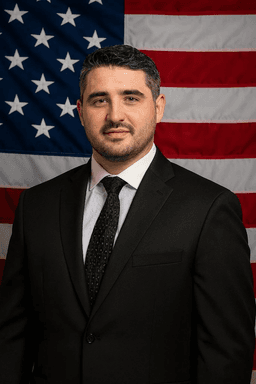 Your attorneyAndranik "Andy" Boyadzhyan, Esq.Founding Attorney. Licensed in Washington, D.C.
Attorney advertising. Services are not available in all states.
By Andranik "Andy" Boyadzhyan, Attorney at Law. Meet the team
In Washington, D.C., every car registered in the District must stay insured for the whole registration period. Drivers who live elsewhere must be insured whenever their car is on District roads. A lapse can bring fines and a suspended registration. Top USA Law can review a District crash claim at no cost. Call today.
The section says a car registered in the District must stay insured the whole time, and a visitor's car must be insured while driven there.
D.C. Code section 31-2403 is titled "Required insurance." Subsection (a) covers owners whose cars are registered in the District or carry a reciprocity sticker. They must keep the required insurance in force for the whole registration period, with no gaps. Subsection (b) covers people who live outside the District. They may not drive their car in the District, or let anyone else drive it there, unless it is insured while it is there.
Subsection (c) says the insurance can come from a policy written by an insurer allowed to do business in the District, or another method the insurance commissioner approves. Subsection (d) deals with proof. When you register a car or apply for a reciprocity sticker, you certify to the DMV on its form that the car is insured. The section does not list dollar amounts. Another section of the same chapter sets them.
Top USA Law handles motor vehicle accident claims in the District. Andranik "Andy" Boyadzhyan, the firm's founding attorney, is licensed in Washington, D.C., and clients can meet by phone, by video or in person by arrangement.
Through checks at registration, insurer reports of cancelled policies, fines, registration suspension and, in some cases, immobilizing the uninsured vehicle until coverage is restored.
Under D.C. Code section 31-2403, the DMV may ask your insurer to confirm that you are covered. The insurer must answer within 10 business days. The DMV may also ask you for proof within 15 business days. Insurers must tell the DMV about a cancelled policy within 30 days, and the DMV may check coverage through an online system.
The DMV must suspend the registration or reciprocity sticker of a car that is not insured. The suspension starts 30 days after the DMV mails a notice, unless the owner shows proof of insurance and pays any fines. Until the car is insured again, the DMV or the Metropolitan Police Department may immobilize it. The DC DMV vehicle insurance page adds that lapse fines increase over time and that owners must surrender their tags if coverage ends.
Yes. Subsection (b) applies to nonresidents who own a vehicle and drive it in the District, so a commuter's car must be insured while it is on District streets. The section also lets the DMV require proof of insurance before returning an immobilized vehicle to a nonresident owner.
Top USA Law. Services are not available in all states.
Fill in four quick fields, and a licensed attorney reviews the facts of your case at no cost.
The DC DMV lists 25/50 liability, a property damage minimum, and uninsured motorist coverage for both injuries and property damage.
According to the DC DMV vehicle insurance page, the minimums are $25,000 per person and $50,000 per accident for third party liability, $10,000 for property damage liability, $25,000 per person and $50,000 per accident for uninsured motorist bodily injury, and $5,000 for uninsured motorist property damage, subject to a $200 deductible. Past results do not guarantee a similar outcome. Those amounts are set by D.C. Code section 31-2406; section 31-2403 is the duty to keep that insurance in force.
Because the at-fault driver's insurance, or your own uninsured motorist coverage, is where payment for injuries can come from in the District.
The required uninsured motorist coverage on your own District policy may pay for injuries an uninsured driver caused. Stop, call 911 if anyone is hurt and give your information, as D.C. Code section 50-2201.05c requires, then make sure a police report exists.
D.C. Code section 31-2404 lets a policyholder elect no-fault (PIP) benefits. Someone who elects to receive them may sue another driver only if the injury meets the statute's threshold or medical and rehabilitation expenses or work loss exceed the PIP benefits available.
Under District of Columbia common law, a driver or passenger found even slightly at fault may be barred from recovering. Pedestrians and cyclists have a different rule under the Motor Vehicle Collision Recovery Act, D.C. Code section 50-2204.52.
An injury lawsuit must be filed within three years under D.C. Code section 12-301. A claim against the District government needs written notice to the Mayor within six months under D.C. Code section 12-309.
Related: the three year D.C. deadline, uninsured drivers in D.C. and getting a D.C. crash report.
When the at-fault driver carried only the minimum, two guides pick up from here: an underinsured motorist claim after a District crash and getting a rental car paid for in D.C.
Sue within three years, or two after a death. District claims need Mayor notice in six months; elect PIP in 60 days.
A licensed Washington, D.C. attorney, Andranik "Andy" Boyadzhyan, Founding Attorney, reviews every Washington, D.C. claim, and our team helps you in English or Spanish.
Andranik "Andy" Boyadzhyan, Esq.
Founding Attorney
Licensed in Alabama, Missouri, New Mexico and Washington, D.C.
Featured in CNN, Forbes, Variety

Paul Perkins, Esq.
Of Counsel
Licensed in New Jersey and New York
Certified by the New Jersey Supreme Court as a Civil Trial Attorney. Lawyer of Distinction in Civil Litigation.
Featured in CNBC, Bloomberg, Forbes, The New York Times
Andranik "Andy" Boyadzhyan is the founding attorney of Top USA Law. His background spans business law, civil litigation, and personal injury, and his practice today focuses on motor vehicle accident claims.
Sundas Shafi, Esq., Attorney at Law, Head of Litigation
Rosette Kalayjian, Attorney at Law
Sandra Alves, Case Manager
Four steps from your first call to the close of your claim. You focus on healing while we deal with the insurers and keep you updated.
Free consultation
Call 24/7 or send the short form. An attorney reviews what happened and tells you where you stand. Free, no obligation.
We deal with the insurers
We deal with the insurance companies, request the police report and medical records, and keep you updated.
We build your case
Evidence, witnesses, experts and the medical picture of your injuries, prepared as if the case will go to trial.
You get paid
Medical bills, lost wages, vehicle damage, and pain and suffering. No fee unless we win; costs may apply.
Reviewed by Andranik "Andy" Boyadzhyan, Esq.
Fill in the four short fields in this form, and a licensed attorney reviews your case for free. We respond day or night.
Top USA Law. Services are not available in all states.
Takes 30 seconds. No obligation.