

T Bone Accident
$1,800,000
Insurer offered$120,000
Broken pelvis and internal bleeding at an intersection. The insurer offered $120,000.
Serving Washington, D.C.
Hurt in a crash? The insurance company already has a team working on your claim. You should too. A free call tells you where you stand.
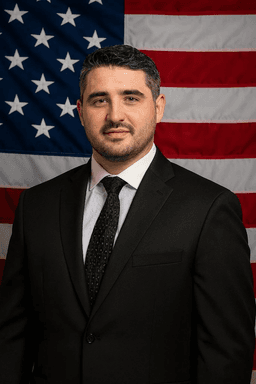 Your attorneyAndranik "Andy" Boyadzhyan, Esq.Founding Attorney. Licensed in Washington, D.C.
Attorney advertising. Services are not available in all states.
By Andranik "Andy" Boyadzhyan, Attorney at Law. Meet the team
In Washington, D.C., the driver who failed to yield is at fault for the T-bone crash, such as a driver who ran a red light, rolled through a stop sign or entered a traffic circle without yielding. Any fault of your own can bar a driver's claim. Top USA Law will review your case for free.
Key takeaways
The driver who broke a District right of way rule is at fault. The rule that applies depends on the signal, sign or circle.
A T-bone or side-impact crash happens when the front of one car hits the side of another. In the District that can be a driver beating a yellow across New York Avenue NE, a car turning left from Georgia Avenue across oncoming traffic, or a driver pushing into the circle at Dupont or Thomas Circle. The District's right of way rules are in its traffic regulations, 18 DCMR 2103 and 2208.
Under 18 DCMR 2208.1, when two vehicles approach or enter an intersection at about the same time, the driver on the left yields to the vehicle on the right. Signals and signs change that baseline, as the table shows.
| Where it happened | Who had to yield or stop | Rule |
|---|---|---|
| Steady red signal | The driver facing red stops and stays stopped; a right on red only after stopping and yielding | 18 DCMR 2103.7 |
| Steady yellow | The driver stops before the crosswalk unless too close to stop safely | 18 DCMR 2103.5 |
| Green, cross traffic still inside | The driver on green yields to vehicles and pedestrians lawfully within the intersection | 18 DCMR 2103.3 |
| Stop sign | Stop, then yield to traffic in or near the intersection | 18 DCMR 2208.3 and 2208.4 |
| Yield sign | Slow, stop if needed and yield; a crash after rolling past without stopping is prima facie evidence of failure to yield | 18 DCMR 2208.5 and 2208.6 |
| Left turn | The turning driver yields to oncoming traffic close enough to be an immediate hazard | 18 DCMR 2208.2 |
| Traffic circle | Entering drivers yield to traffic already in the circle unless signs or signals say otherwise | 18 DCMR 2208.7 |
The driver entering the circle has to yield to traffic already circulating, unless a sign or signal at that circle directs otherwise.
The District's circles are a local feature with their own rule. Under 18 DCMR 2208.7, a driver approaching a traffic circle yields to traffic already within the circle unless official traffic control devices say otherwise. Several of the big circles, such as Dupont Circle, Logan Circle and Washington Circle, have signals at some entries, so the signal, not the general rule, may control at that entry. Photograph the signal heads and signs at the exact entry point used by each car.
Top USA Law. Services are not available in all states.
Fill in four quick fields, and a licensed attorney reviews the facts of your case at no cost.
For a driver or passenger, any contributory negligence can bar the claim under District common law, so even a small share of fault matters.
The District follows contributory negligence for claims between motorists. Under District of Columbia common law, a driver who contributed to the crash in any degree may recover nothing from the other driver. That makes the defense's job simple: find one thing you did wrong. In a broadside case, the arguments can be that you were speeding through the green, looking at a phone, or entered on a stale yellow.
Not wearing a seat belt is not one of those arguments. Under D.C. Code section 50-1807, a seat belt violation is not evidence of negligence or contributory negligence and cannot be used to reduce damages. Our page on being partly at fault in D.C. explains the doctrine and its limits.
The Collision Recovery Act protects you. Your own negligence bars recovery only if it was a proximate cause and greater than all defendants' combined.
Under the Motor Vehicle Collision Recovery Act, D.C. Code section 50-2204.52, a pedestrian or vulnerable user hit by a motor vehicle is not barred by their own negligence unless it was a proximate cause of the crash and greater than the combined negligence of all defendants. D.C. Code section 50-2204.51 defines vulnerable users to include people using a bicycle, motorcycle, motorized bicycle, scooter or similar device. A rider struck broadside by a car running a red light on Connecticut Avenue is judged under this rule, not the contributory negligence rule. See our Collision Recovery Act guide.
Video, the police crash report, the vehicles and witnesses prove it. Because slight fault can bar a driver's claim, gather it early.
What a case like this is worth: value depends on the injury, treatment, lost work, the PIP election and the insurance available. Read how D.C. car accident settlements are valued.
Side-impact cases can take longer when both drivers claim a green light. The stages of a D.C. Superior Court car case and a realistic timeline for a District claim show where the time goes. If an adjuster offers money before the light question is settled, deciding on a first insurance offer in D.C. explains what to check.
In each case, the insurance company made a first offer. Here is what our clients received instead. Past results do not guarantee a similar outcome.
T Bone Accident
$1,800,000
Insurer offered$120,000
Broken pelvis and internal bleeding at an intersection. The insurer offered $120,000.
Every case is different. Past results do not guarantee, warrant, or predict a similar outcome.
If you bought PIP, it pays regardless of fault once you elect it within 60 days. Otherwise health insurance and the at-fault driver pay.
PIP is optional in the District. Under D.C. Code section 31-2404, insurers must offer it, and it pays medical and rehabilitation expenses, work loss and funeral benefits without regard to fault. Under D.C. Code section 31-2405, a victim must tell the PIP insurer within 60 days whether they elect PIP. Electing it limits a lawsuit against the other driver to cases that meet the statutory threshold, such as substantial permanent scarring or disfigurement, a substantial and medically demonstrable permanent impairment that significantly affected work or usual daily activities, or more than 180 continuous days unable to do usual activities, or where medical and rehabilitation expenses or work loss exceed the PIP benefits available. Our D.C. no-fault option guide walks through the choice. If neck or back pain follows the crash, see chiropractic care after a D.C. crash.
The PIP election runs 60 days, a District claim's notice to the Mayor six months, the injury lawsuit three years, a death claim two.
Talk to a lawyer before any recorded statement and whenever the other driver blames you, since proven fault of your own can end the claim.
Top USA Law's Washington, D.C. office is at 700 12th St NW, Suite 700. District cases are filed in the Superior Court of the District of Columbia, Civil Division; our D.C. Superior Court guide explains the process. Andranik "Andy" Boyadzhyan, Attorney at Law, licensed in Washington, D.C., wrote this page. We meet clients by phone, by video or in person, and you pay no fee unless we win, and costs may apply. See our Washington, D.C. car accident lawyer page and what to do after a D.C. crash.
Related Washington, D.C. questions: rear-end collision claims, total loss car claims, uninsured drivers.
A pedestrian caught in a side impact at an intersection has different fault rules, explained on the Washington, D.C. pedestrian accident attorney page, and the District rules for drivers are on the Washington, D.C. car accident lawyer page.
Sue within three years, or two after a death. District claims need Mayor notice in six months; elect PIP in 60 days.
A licensed Washington, D.C. attorney, Andranik "Andy" Boyadzhyan, Founding Attorney, reviews every Washington, D.C. claim, and our team helps you in English or Spanish.

Andranik "Andy" Boyadzhyan, Esq.
Founding Attorney
Licensed in Alabama, Missouri, New Mexico and Washington, D.C.
Featured in CNN, Forbes, Variety

Paul Perkins, Esq.
Of Counsel
Licensed in New Jersey and New York
Certified by the New Jersey Supreme Court as a Civil Trial Attorney. Lawyer of Distinction in Civil Litigation.
Featured in CNBC, Bloomberg, Forbes, The New York Times
Andranik "Andy" Boyadzhyan is the founding attorney of Top USA Law. His background spans business law, civil litigation, and personal injury, and his practice today focuses on motor vehicle accident claims.
Sundas Shafi, Esq., Attorney at Law, Head of Litigation
Rosette Kalayjian, Attorney at Law
Sandra Alves, Case Manager
Four steps from your first call to the close of your claim. You focus on healing while we deal with the insurers and keep you updated.
Free consultation
Call 24/7 or send the short form. An attorney reviews what happened and tells you where you stand. Free, no obligation.
We deal with the insurers
We deal with the insurance companies, request the police report and medical records, and keep you updated.
We build your case
Evidence, witnesses, experts and the medical picture of your injuries, prepared as if the case will go to trial.
You get paid
Medical bills, lost wages, vehicle damage, and pain and suffering. No fee unless we win; costs may apply.
Reviewed by Andranik "Andy" Boyadzhyan, Esq.
Fill in the four short fields in this form, and a licensed attorney reviews your case for free. We respond day or night.
Top USA Law. Services are not available in all states.
Takes 30 seconds. No obligation.